
Christmas cookie cutter STL files to 3D print
2026-08-15
Every December I end up printing more cutters than I bake with, and I have stopped feeling bad about it. A christmas cookie cutter stl file costs you a few grams of filament and an hour on the bed, and you get a cutter sized exactly for the tray you are filling. The plastic packs at the shops are the opposite deal: five shapes, one size each, and a tree that is always slightly too big for a gift bag. Free Christmas cookie cutter STL files are easy to come by, and once you have printed a couple you tend to stop buying cutters entirely.
The other thing that sold me is timing. You can decide at eight at night that you need a star, and by nine you are cutting with it. Lose one in the drawer or snap it, print another. Need the same shape at half the size for gift tags, print it small. That is the whole argument for 3D printing your own Christmas cutters, and it holds up every year.
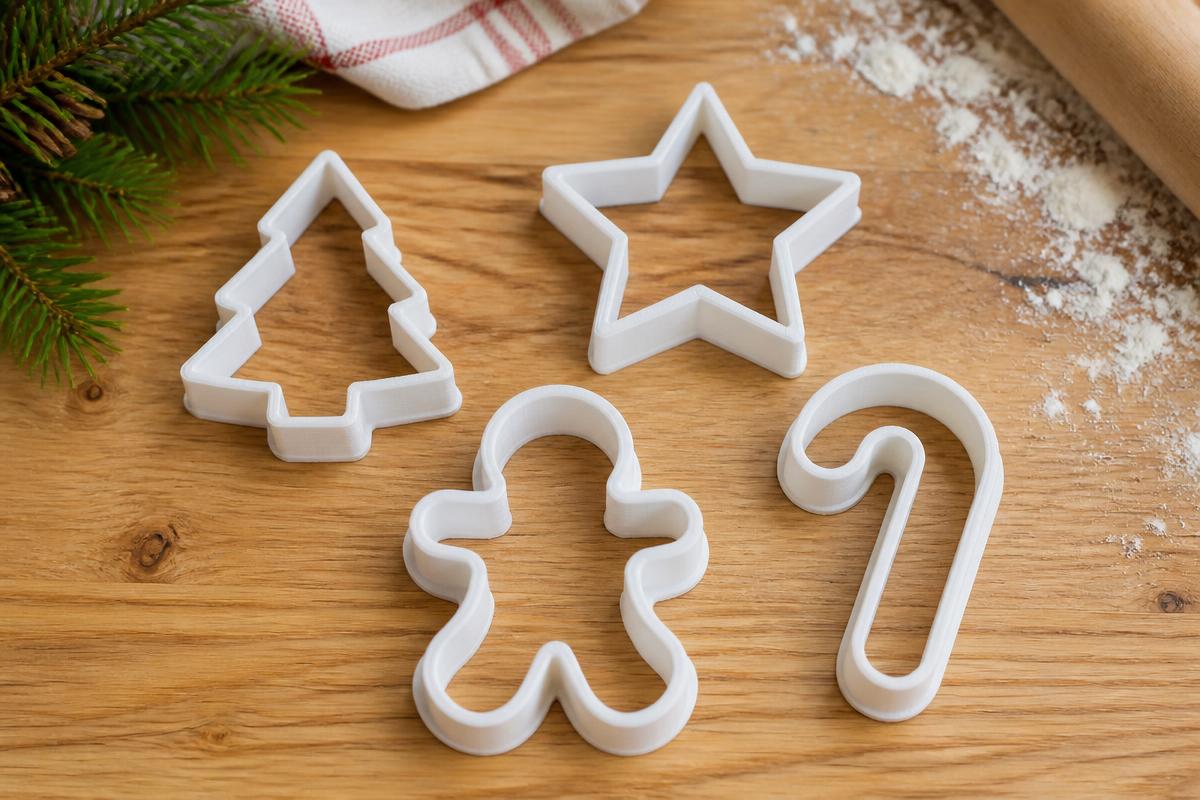
The Christmas shapes everyone actually uses
Every year I print a shortlist and every year it is more or less the same ten. Here they are with what each one is actually like to print and press.
- Christmas tree — the workhorse. Straight zig-zag edges cut clean, release easily, and it reads as Christmas at any size from 4cm up.
- Gingerbread man — thick limbs, no fine detail, very forgiving. The one shape where a matching stamp changes everything, because the face and buttons come from the press rather than a piping bag.
- Star — the other workhorse. Five points, wide angles, no weak spots. If you only print two cutters, print the tree and the star.
- Snowflake — the pretty one and the fragile one. Thin arms mean a thin blade span, so it flexes in the hand and the dough can tear between points. Print it a size bigger than feels right and you will get away with it.
- Candy cane — a long narrow hook. It cuts beautifully but the cookies snap at the bend if you roll thin, so keep the dough a touch thicker for these.
- Bauble or ornament — basically a circle with a little cap. Easiest cut on the list and the best canvas for a stamp or a fondant panel.
- Stocking — a nice silhouette with one tight inner corner at the heel. Dust that corner if the dough clings.
- Snowman — two or three stacked circles, which means two narrow waists. Press straight down and lift straight up so the waists do not distort.
- Reindeer — antlers are the whole story. A small reindeer loses them in the dough, so print this one at 8cm or more and the antlers survive the bake.
- Gift box — square with a bow on top. Simple, fast, and it stacks tidily on a plate, which matters more than it sounds when you are filling boxes.
If you are printing for someone else's kitchen, trees and stars are what get used. Snowflakes and reindeer are what get photographed.
Multi-size sets are the trick
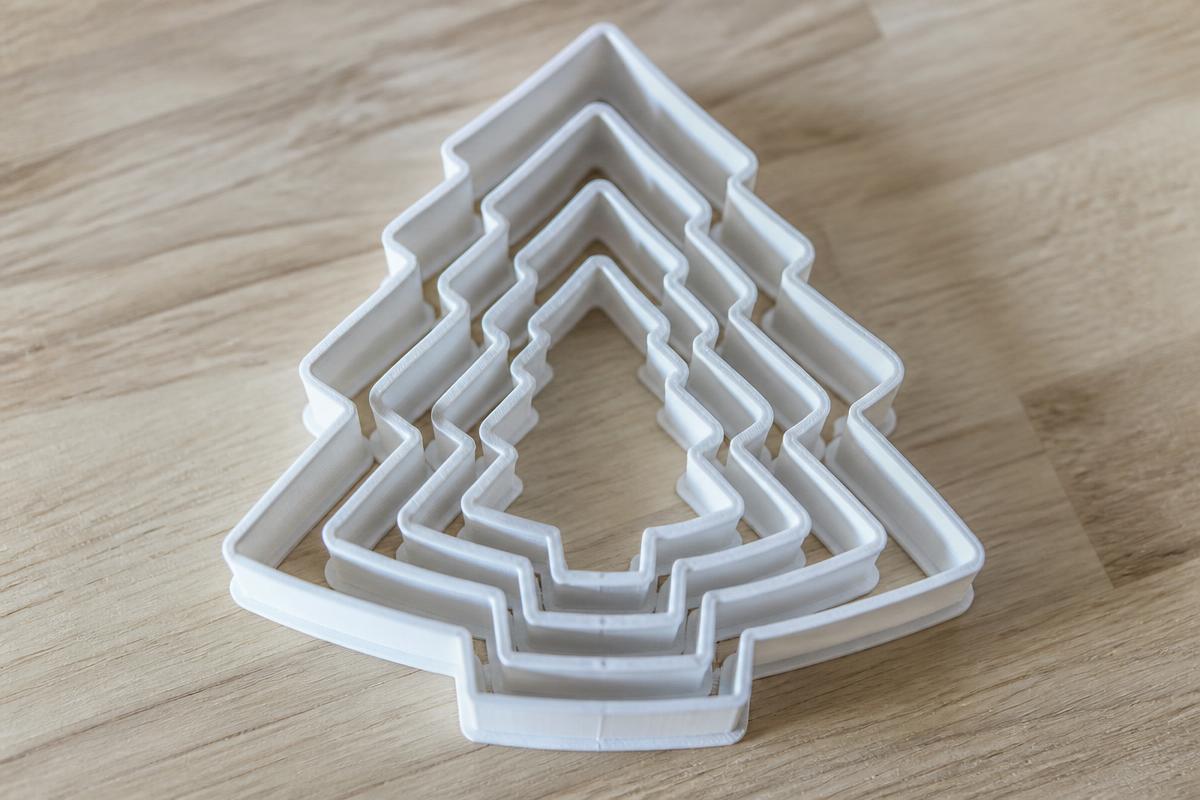
A single cutter solves one cookie. A size run solves a tray. I print the same shape at 4, 6, 8 and 10cm, and each size ends up with its own job.
The 4cm ones are gift-tag cookies — the little ones you tie to a present or scatter around a platter. 6cm is the biscuit-tin size, the one you actually bake fifty of. 8cm is a proper decorated cookie with room for a name or a pattern. 10cm is the centrepiece, one per plate, the one you hand to the kid who asked.
Printing a run costs almost nothing extra because they all go on one plate, and the small ones fit inside the big ones for storage. This is where 3D printing quietly beats buying: nobody sells you the exact ladder of sizes you want, but a generator will make it while you make dough.
One thing to watch as you scale down: fine features shrink faster than you expect. A 10cm reindeer has antlers; the same file at 4cm has bumps. Keep the fiddly shapes big and the simple shapes small.
Matching stamps take them from cut-out to decorated
A cutter gives you a shape. A stamp gives you a decorated cookie without any icing skill at all, which is the part most people are quietly worried about.
A stamp is a flat plate carrying the inner detail of the design in shallow raised relief, mirrored so it presses the right way round. You cut the shape, then press the stamp into the raw dough, or into a fondant panel you lay on a baked cookie. The detail comes out debossed and holds through the oven.
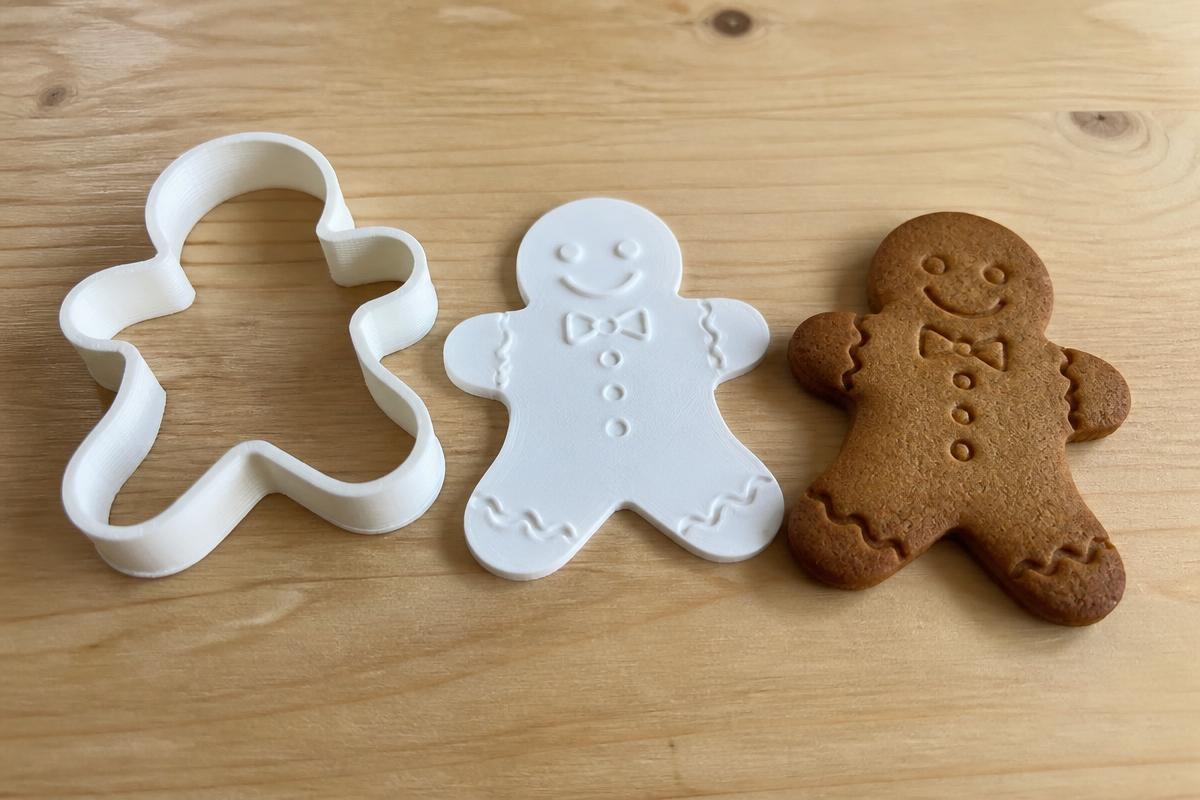
The gingerbread man is the example that convinces people. Plain cut-out gingerbread men need a face piped on, one at a time, forty times. With a stamp you press a smile, two eyes, a bow and three buttons in one motion, and every cookie on the tray matches. A christmas cookie stamp does the same trick for a bauble pattern, a snowflake fill or a tree with baubles on the branches.
Keep the relief shallow. A millimetre or so of detail leaves a crisp shadow line; go deeper and the dough closes the trench back up as it relaxes and spreads.
Spelling names and messages on Christmas cookies
The cookies people keep are the ones with a name on them. NOEL across a row of baubles, JOY on a plate of rounds, one name per cookie so everyone at the table knows which is theirs.
That is a job for letter tiles rather than a cutter. Each letter is its own small printed tile with a raised mirrored letter on the face, and they slide into a holder rail in word order so the whole word presses level in one go. Load the rail, press once, and the spacing is even without any eyeballing.
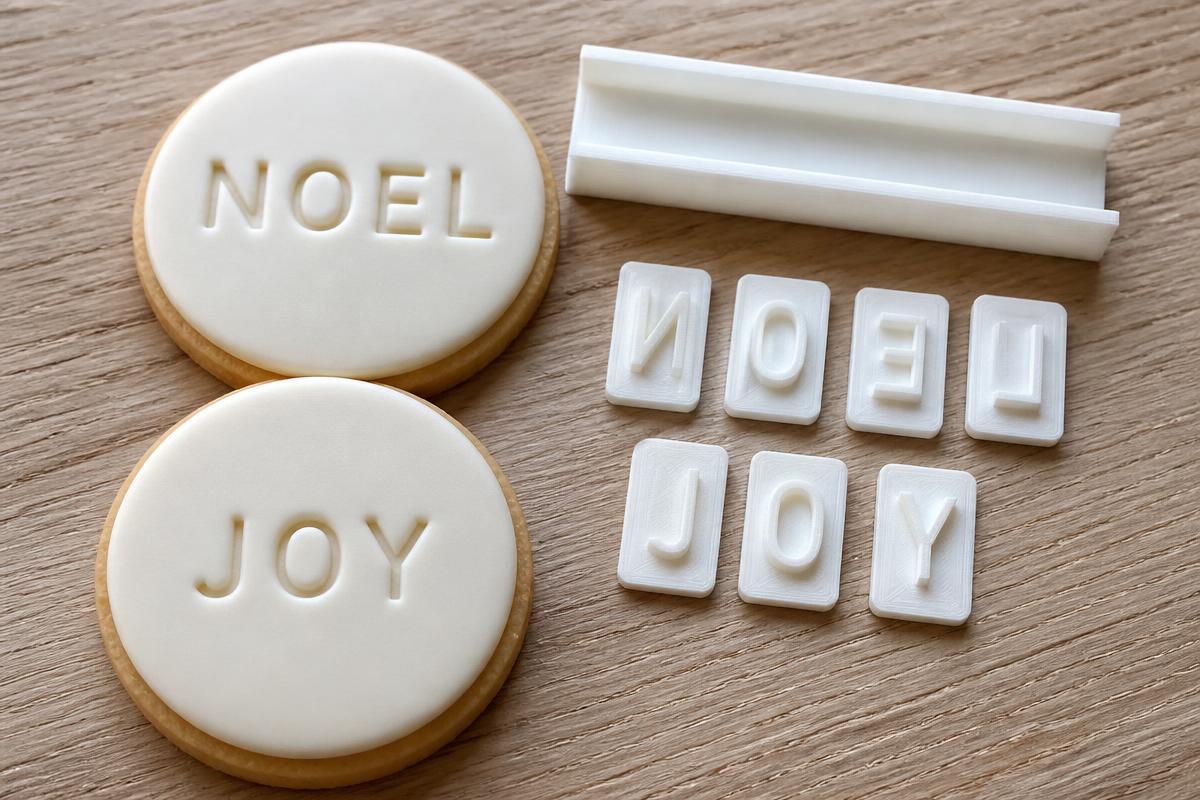
Print spares of the repeated letters before you start. MERRY needs two Rs, CHRISTMAS needs two Ss, and there is nothing more annoying than slicing one tile on the night. A couple of extra vowels and an extra L, N, S and T covers most Christmas words and every family name you will be asked for. Read the full alphabet cookie stamp guide.
Can't find the shape you want? Type it
The classics are easy to find. The specific thing in your head is not, and that is where most Christmas cutter hunts die — half an hour of scrolling for a shape nobody has made.
BakeShape takes the idea in words. Describe it — a bauble with a snowflake pattern, a dachshund in a santa hat, a pudding with a sprig on top, your dog in a scarf — and it draws the outline, thickens it into a real cutter with a tapered cutting edge and a flange you can press on, and builds the matching stamp from the inner detail at the same time. You pick the size, so a custom christmas cookie cutter comes out at 4cm for gift tags or 10cm for the centrepiece from the same description.
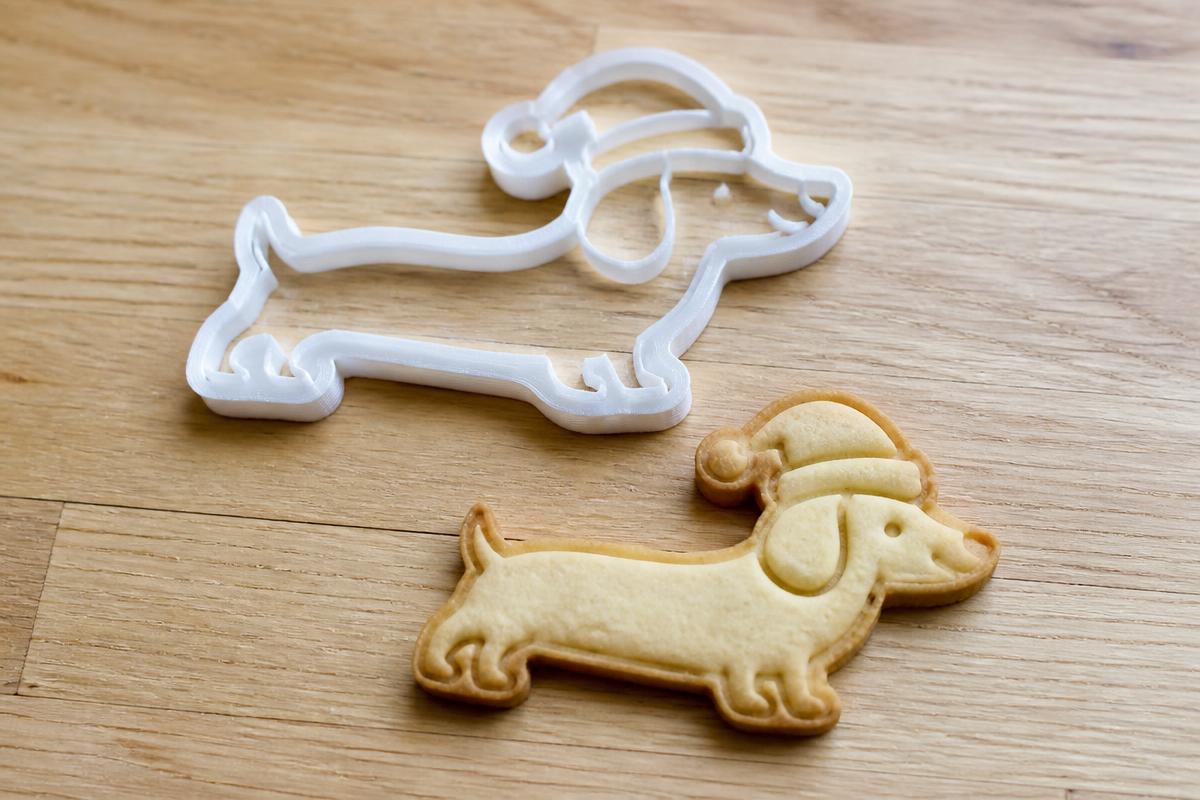
What you get out is a watertight STL, ready to slice, plus the stamp if you want one. No modelling, no tracing, no drawing ability required.
If you would rather skip the drawing step altogether, we keep a small shelf of ready-made Christmas sets — cutter plus matching stamp, print-ready, no supports. Free Christmas cookie cutter STL files.
Printing a batch before Christmas
December printing is batch printing. Fill the plate — six to eight cutters go on a standard bed comfortably — and run it while you do something else. Group the same size together so they all finish at the same height and you can lift the lot off in one go.
- Use your quality preset. Thin layers show up on the cutting edge more than anywhere else on the part.
- Cutters print blade-up straight off the plate, with no supports. The flange is the base and the taper is drawn so nothing overhangs.
- Do a test cookie before the big bake. One cut and one press tells you whether the size and the press depth are right, and it costs you a scrap of dough.
- Slow the outer wall down a little. Ringing on a curve is what makes a cut edge look fuzzy.
- Check the first layer is properly squished. A lifting flange corner throws the press depth off on one side.
- Hand wash before first use. Hand wash only — no dishwasher.
Then get ahead of yourself. Print the shapes in early December, keep them in a labelled bag with the sizes written on it, and next year you start with a full drawer instead of a shopping list.
Questions I get asked
Where can I get free Christmas cookie cutter STL files?
The big model libraries all have Christmas sections with free trees, stars, gingerbread men and snowflakes, and plenty of them print well. The catch is that you are limited to shapes and sizes other people happened to publish, so if the exact shape or size is not there, generating your own is usually quicker than hunting.
Can I 3D print a cookie cutter overnight?
Easily — a single cutter is usually well under an hour on a quality preset, and a full plate of six to eight runs in a few hours. Deciding on a shape in the evening and cutting dough with it the next morning is a completely normal turnaround.
How do I make a custom Christmas cookie cutter?
Describe the shape you want in BakeShape, pick the size, and it draws the outline and builds a printable cutter with a tapered cutting edge and a flange. A matching stamp for the inner detail comes out of the same design, and both download as watertight STLs ready to slice.
What size should Christmas cookie cutters be?
For most trays, 6-8cm across the longest side is the sweet spot — big enough to decorate, small enough to bake a lot of. Drop to 4cm for gift-tag cookies and go up to 10cm for centrepieces, and keep detailed shapes like reindeer at the larger end so the fine parts survive.